
Off With Their Heads

On the eve of war, Paris’ chief executioner died on his way to a beheading. On 2nd February 1939, Anatole Deibler collapsed on the platform of the Porte de Saint Cloud métro station en route to Rennes for the beheading of a murderer. At age 75, it was a heart attack that finally put an end to Deibler’s 40 year long career as one of France’s last professional bourreau.
A Lean, Mean Killing Machine
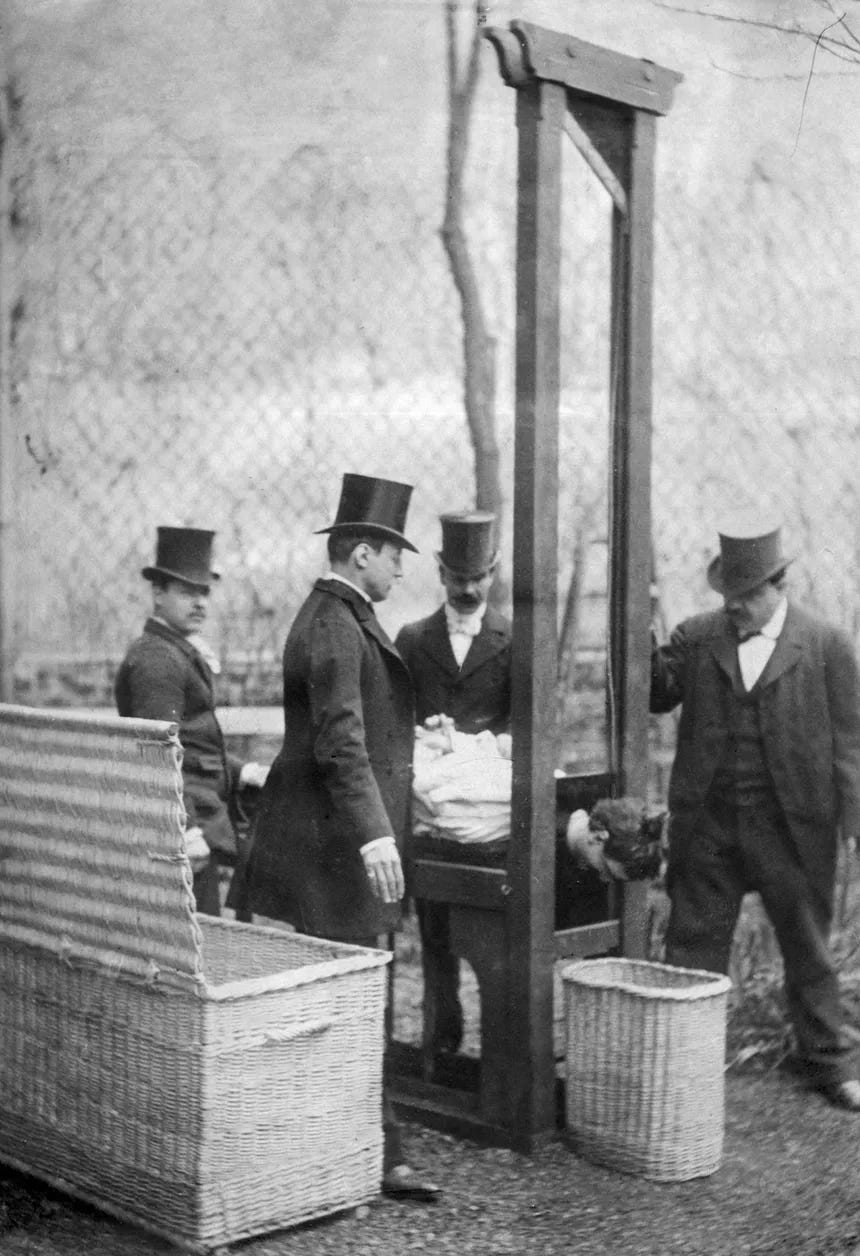
The guillotine itself dates back to 1792 and the French Revolution. It was designed as a more humane way of doling out capital punishment. Joseph-Ignace Guillotin was involved in passing a law in the French Assemblée Nationale meaning that all capital punishment must be done with a machine. The inventor of the guillotine (the nicknames muddy the waters) was actually Antoine Louis, a surgeon. At first the machine was known as a louisette or louison after its inventor, or alternatively and more morbidly, as The Widow, though soon the name guillotine stuck. The machine became the method of choice of executions and remained in use until 1977, reaching just shy of its 200th birthday.1 The essential design never changed, although it was adapted with new technology. By the time Deibler was in the job, the guillotine’s knife would be on wheels to allow it to drop faster and more cleanly, and the structure would be equipped with shock absorbers. These were hefty machines, the side posts weighing around 75kg each. Although often depicted wider and more imposing, traditional guillotine posts are set apart by the width of one and a half times the average adult man’s neck, reaching up about 15 feet into the sky. The deadly blade would weigh about 7kg and would be put in place just before the execution was due to take place, off-set with counterweights and ready to drop onto the neck of the unfortunate beneath.
The Practicalities of Beheadings
The date of executions were kept secret, with only the judges, prosecutors, and - of course - the executioner being in the know. Despite this, word often got out and large crowds would amass to witness (or, more realistically, hear) what they could of the event. Police would barricade the crowd from direct view, but this didn’t stop the wealthier among them paying to access apartments from where they had a clear line of site. The executioner and his aides (known as valets) were charged with setting up the machine in the earliest hours of the day as executions took place at dawn. They would build the machine as quietly as possible, trying not to alert the prisoners to their fate, and despite the complexity and sturdiness of the machine it took them only about an hour to do so. There was no need for tools as the pieces of the machine were numbered and slotted into each other. Deibler had two guillotines which he had inherited from his father and grandfather before him. One was smaller and lighter, often used for travelling and nicknamed La Fifille (the little girl). The larger, as per tradition, was La Veuve (the widow). Of the component parts the blade was naturally the most important. Deilber took great care of his equipment and even kept the blades of his machines in vaseline when not in use.2 This kept them in much better condition and meant they would last for years with little maintenance needed. The writer Janet Flanner reflected that the blades Deibler used were made from welded steel and bronze that came from Langres, ‘the cutlery center of France’.3 The sharper the blade, the more precise and painless the execution would be, as was the original goal. Once the prisoner was in place, the whole matter would be over in about ten seconds.
The Monsieur Himself
According to traditions dating back before Louis XVI’s execution, Paris’ chief executioner was known as the Monsieur de Paris. This Monsieur Deibler was not the first Monsieur Deibler to hold the title; he was to become the third, following the paternal career path laid out for him. This was common, as given the grisly nature of the profession, the job remained within families, whether by blood or marriage. Deibler, however, tried to escape his fate. He began by working in a large Parisian department store but soon came to realise that he had little choice in the matter. He trained under his grandfather before becoming his father’s valet in Paris, from whom he took over once his father had experienced a traumatising execution and developed a phobia to blood. Anatole Deibler therefore became the new Monsieur de Paris. Deibler wanted to live a normal life but his profession made this impossible. In 1870, a decree was passed to dispense of provincial executioners, leaving only the chief executioner. This brought more curiosity to the career and, therefore, a lot more attention. Deibler felt this particularly, using a false name when travelling and trying to avoid being recognised. The position of Monsieur de Paris had gone from pariah to celebrity.4 He retreated, rarely going out and, when he did, often alone. While he didn’t have many friends (and those that he did have were through work), he did have a family. The year before the title was conferred upon him, he married Rosine Rogis who he had met at a cycling event. The couple had a son who died at a month old after receiving a bad prescription, but then went on to have two daughters. Rosine insisted that neither of her daughters would marry an executioner, despite herself coming from a family of the same profession. As Deibler did not have a male heir to work with, he took on his wife’s nephew, André Obrecht as one of his valets. At one point in his career, Deibler tried to resign but he was told he would not receive his full-pay pension, to which French executioners have always been entitled. Instead, he continued working.
Leaving a Legacy
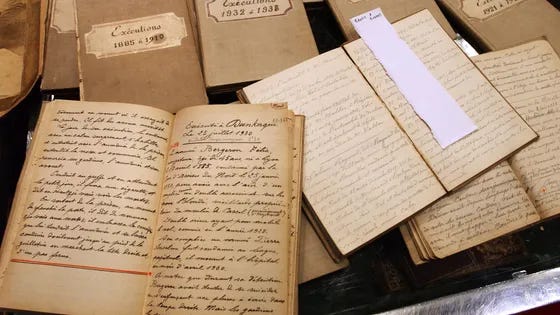
The Monsieur de Paris traditionally selected their own successor. In 1908, Deibler met Jules-Henri Desfourneaux who became one of his valets and later married his niece, Georgette Rogis. After Deibler’s death, it was Desfourneaux who took over as the chief executioner, despite the 200 or so applications that came in to fill the position. André Obrecht, Deibler’s nephew, would hold the role in the coming years and finally Marcel Chevalier, the last executioner of France, who also had familial links by marriage to Deibler and worked as one of Obrecht’s valets. Although not quite the neat dynasty of other executioner families in the past who saw the job go from father to son directly, Deilber did have his descendants carry on his position. As a final legacy, Deilber also left behind something of particular note. Throughout his career he maintained notebooks of all the criminals he beheaded. He detailed their crimes as well as including their mugshots (still a relatively new phenomenon). These notebooks were put up for auction in 2003 and fetched a sum of €85,000.5 Across his career, Deibler performed hundreds of executions - this is the only thing that can be agreed on, since depending on the source the actual number was anywhere between 299 and 400. He was well-respected in his profession, taking no pleasure in the work but committing to it; he saw himself not as a murderer, but rather as carrying out a justice that had begun with jury and judge.
Anatole Deibler is buried at the Cimetière de l'Ouest in the outskirts of Paris in the family sepulchre.
Public executions came to an end in 1939 after a crowd became too rowdy, with the exception of the final guillotining in 1977 which was held in public.
Janet Flanner, An American in Paris: Profile of an Interlude Between Two Wars
ibid
Pierre Ropert, https://www.radiofrance.fr/franceculture/les-dynasties-de-bourreaux-executeurs-de-peres-en-fils-4235081
https://reuters.screenocean.com/record/845035